SegWit & Taproot
These adopted changes operate within Bitcoin mainnet. They demonstrate why “no rule has ever changed” would be an inaccurate definition of BTC.[3][5]
 Spark HouseWhere Creativity WorksVolunteer Sign In
A CLEAR ASSET MANDATE
This project supports native BTC on Bitcoin mainnet. It rejects substitutes while examining their claimed benefits and real risks with care.
A PRACTICAL GUIDE FOR COMMUNITY ORGANIZATIONS
A printable guide for Lions clubs, Knights of Columbus councils and assemblies, foundations and other community organizations. It covers governing documents, custody, gifts, payments, officer succession and the ethical questions of Magnifica Humanitas.
Research edition 1 · 9 October 2026. Independent Spark House publication with linked sources and original diagrams. Proposed procedures require adoption under the actual organization’s rules; the guide supplies no receiving address or authorization to hold BTC.
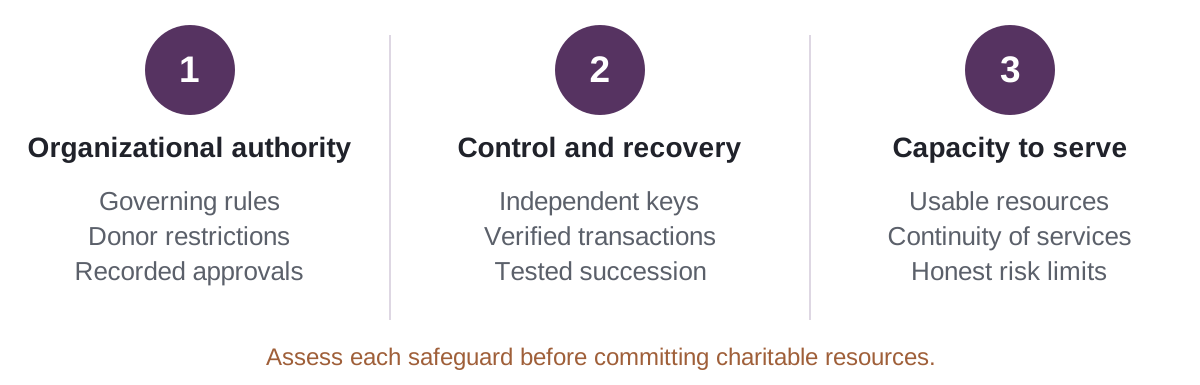
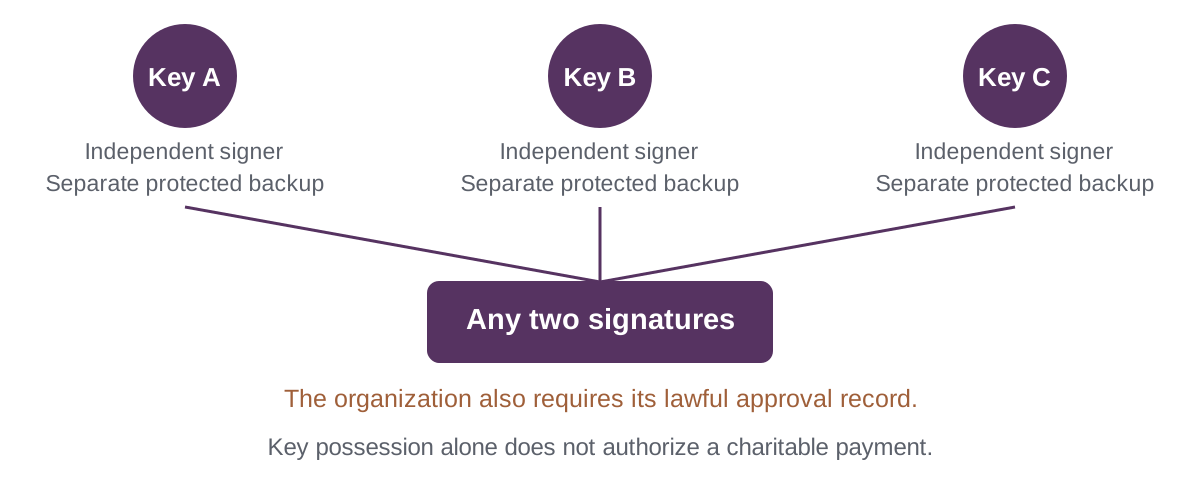
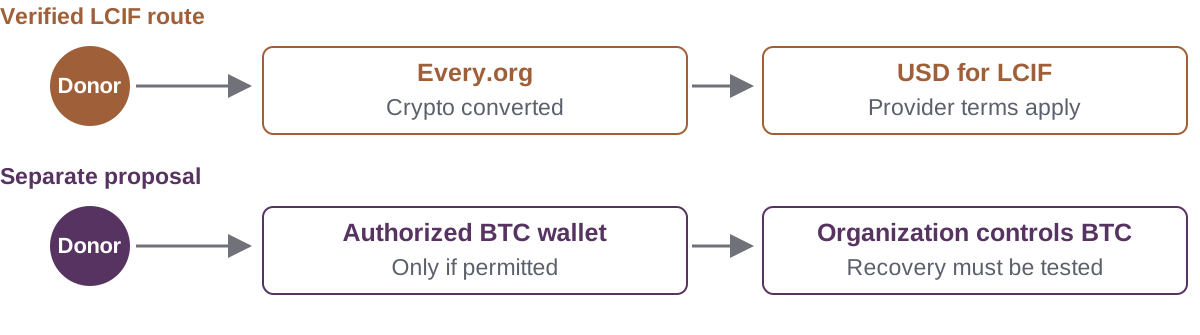
Original diagrams: Three safeguards · Shared custody · Gift routes
PROJECT POLICY · NATIVE BITCOIN ONLY
For this Bitcoin project, Spark House disavows independent fork currencies and every separate cryptocurrency derived from Bitcoin that changes its rules. It also excludes all other tokens, wrapped or synthetic BTC, stablecoins, lending, leverage and financial derivatives from the project treasury.
We disavow outside arrangements that introduce unwanted monetary or counterparty exposure: USD and other conventional currencies, fiat pegs, automatic conversion, conventional trade or currency schemes used as substitutes for BTC, and third-party claims presented as Bitcoin. No outside party may redefine a contribution’s asset, pledge project BTC, or attach new redemption conditions.
The mandate is native BTC on Bitcoin mainnet, accounted for in BTC and satoshis. It does not promise a fixed exchange rate, purchasing power or risk-free outcome. Any legally required reporting valuation is accounting, not permission to convert the treasury. This project’s mandate does not rewrite other Spark House programs’ payment arrangements.
The rule-change distinction matters. Today’s Bitcoin is not an unchanged copy of 2009 software. SegWit and Taproot are deployed consensus changes within Bitcoin mainnet. This policy rejects independent assets—including every rule-changing descendant of Bitcoin—while identifying BTC by the Bitcoin mainnet followed by its validating participants. It does not pretend that software governance or future disagreements disappear.[2][3][5]
The asset mandate is the project’s stated policy. The custody and public-contribution procedures on /bitcoin remain proposed until the actual recipient, signers, wallet and gift terms are verified. These pages provide no deposit address, automated conversion, trade execution or investment offering.
02ANCESTRY IS NOT IDENTITY
A chain split, a copied codebase and a token representing an asset are different structures. None turns a separate asset into native Bitcoin.
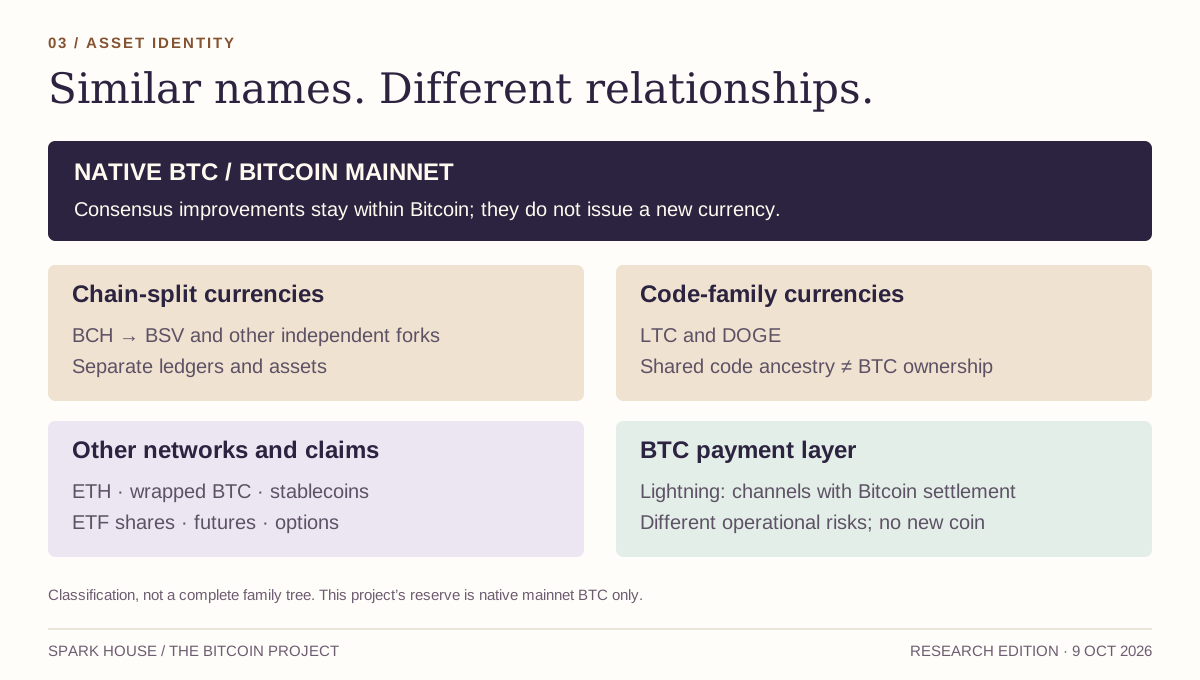
| Asset / relationship | Purpose or possible benefit | Distinct rules and risks | Project status |
|---|---|---|---|
| Bitcoin Cash (BCH) 2017 Bitcoin chain split | Emphasizes larger on-chain capacity and everyday payments. | A separate ledger and asset with different consensus and ecosystem decisions. Capacity does not itself prove superior security, liquidity or decentralization.[45] | Disavowed / excluded |
| Bitcoin SV (BSV) 2018 split from BCH | Promotes large-scale on-chain processing and data applications. | Changed validation/configuration and potentially substantial node resource requirements. A claim to the original vision does not make BSV a BTC balance.[46][47] | Disavowed / excluded |
| Litecoin (LTC) Bitcoin code ancestry | Designed for payments with different timing and mining parameters. | Separate issuance, security economics, market and implementation. Code reuse does not preserve the same monetary rules.[48] | Disavowed / excluded |
| Dogecoin (DOGE) Code-family descendant | Payment and tipping emphasis; continuing issuance is presented as supporting circulation. | Roughly five billion additional coins annually, with no Bitcoin-style terminal cap. Predictable issuance does not mean a stable price.[49][50] | Disavowed / excluded |
| Ethereum (ETH) and application tokens Separate ecosystem; not a Bitcoin chain fork | Programmable applications; proof-of-stake validation avoids proof-of-work mining. | Different monetary and consensus rules; staking penalties, application bugs, bridge or custodian dependencies vary by use. Smart contracts cannot guarantee their external inputs.[51] | Excluded |
| All other independent forks and tokens | Design goals vary and should be examined from their own specifications. | No name, common history or claimed peg grants Bitcoin mainnet spending authority. The examples above are not an exhaustive inventory. | Excluded |
Benefits in this table describe intended uses or structural possibilities, not verified superiority or investment recommendations. Avoid exposing a BTC private key to a fork-claiming service; the prospect of an additional asset is not a reason to compromise the original custody.[9]
03TOKENS, SECURITIES & DERIVATIVES
A product can track Bitcoin, hold it in custody or promise delivery without giving its holder direct control of a Bitcoin output. Spot fund shares, wrapped tokens and derivatives are also distinct from one another.
| Product | Possible benefit | Material risks and limits |
|---|---|---|
| Wrapped BTC / bridges | Use BTC-linked value in another network’s applications or as collateral. | Custodian or bridge failure, reserve shortfall, contract exploits, redemption restrictions and liquidation in collateralized applications. A claimed 1:1 backing is not a native BTC output under the holder’s key.[52] |
| USD stablecoins | Token transfers with a target nominal fiat value; integration with digital markets. | Retain USD exposure and add issuer, reserve, bank, eligibility, freezing and depegging risks. A peg is a mechanism or promise, not certainty.[53] |
| Spot Bitcoin ETF / trust shares | Brokerage access and outsourced custody for Bitcoin price exposure. | Fees, custody and legal-structure risks, trading-hours constraints and possible premium/discount. Investor rights follow the product documents; owning shares is not holding a private key. Spot shares are not themselves futures.[54] |
| Futures | Hedge a price exposure or take a position without immediate spot delivery. | Margin, liquidation, basis and rollover risk; settlement and counterparty rules matter. CME’s referenced Bitcoin contract is cash settled, not a means of redeeming a copper coin.[55][56] |
| Options | Shape exposure; a purchased, fully paid option can bound the option buyer’s loss to the premium and costs. | Expiry, time decay, pricing complexity, liquidity and exercise terms. Uncovered writers can face much larger losses. Buying an option does not protect against every treasury risk.[56] |
| Perpetuals and leveraged products | Continuous directional exposure or a hedge without a conventional expiry. | Funding payments, mark-price/oracle design, collateral rules, forced liquidation and platform insolvency. Terms vary; advertised leverage magnifies error as well as gains. |
| Lending and “yield” accounts | Potential interest or rewards from lending, market-making or collateral use. | Credit/default, rehypothecation, withdrawal freezes and legal priority in insolvency; sometimes additional smart-contract risk. Native Bitcoin does not pay protocol staking interest merely for being held. |
Perpetual and lending risks above are structural analysis, not an audit of any named provider. Their exact terms would require a separate review. All listed products are excluded from this project’s reserve, even when used elsewhere for legitimate hedging or convenience.
Ethical precision matters. The Vatican’s Oeconomicae et pecuniariae quaestiones recognizes a risk-insurance role for derivatives while criticizing opaque, risk-distorting complexity. The project chooses a stricter BTC-only mandate; it does not attribute a blanket ecclesiastical prohibition to that text.[22]
04BITCOIN ITSELF & ITS PAYMENT LAYERS
These adopted changes operate within Bitcoin mainnet. They demonstrate why “no rule has ever changed” would be an inaccurate definition of BTC.[3][5]
Channels move BTC off-chain with on-chain enforcement. Useful for fast, small payments, they require different liquidity, monitoring and recovery practices from an untouched cold reserve.[16][17]
A provider may use Bitcoin or Lightning while retaining control of the actual keys. Its customer balance is a claim on that provider. Product branding alone does not resolve custody.[9]
The project reserve mandate is native BTC on mainnet. No Lightning service or other layer is enabled by these pages. Any future operational payment method would require explicit review of its custody, liquidity, recovery and accounting; it cannot silently replace the reserve.
05CONVENTIONAL MONEY & REMAINING RISK
The project disavows USD and other conventional currency exposure as a treasury or redemption substitute. This is a chosen mandate, not a scientific finding that conventional money has no useful functions or that BTC has no uncertainty.
Fiat value depends on monetary policy and economic conditions; balances held through institutions add institutional exposure. The Federal Reserve’s longer-run objective is 2% PCE inflation—not a promise that current or future inflation will equal 2%. The project avoids fiat pegs, automatic exchange and fiat-denominated guarantees.[57]
It also rejects outside trade, lending or custody arrangements that pledge the project’s BTC, alter the agreed asset, or introduce obligations contributors did not authorize. These exclusions should be reflected in signed contribution and custody terms.
BTC’s purchasing power still changes. Fees, operational costs, legal obligations and real-world counterparties remain. A BTC-only treasury cannot promise the same future quantity of food, labor, electricity or any other good.[41]
Conventional banking can offer familiar payment and accounting functions and, for eligible deposits, statutory insurance. FDIC coverage has limits and conditions; it does not insure BTC or guarantee any asset’s market price. Acknowledging those protections is compatible with choosing not to use fiat for this project.[58]
06SOURCE ANNOTATIONS
The same reference set supports both project pages. Each record identifies the authority, reading scope and limitations. The list is curated and expandable, not a claim to cover every serious publication.
58 of 58 references · reviewed 9 October 2026
Foundational design for peer-to-peer electronic cash and double-spend resistance.
The deployed change prevents undefined large right shifts from allowing subsidy calculation to restart after 64 halvings.
The document marks SegWit as deployed and as a consensus soft fork.
The deployed specification defines 64-byte Schnorr signatures over secp256k1.
The deployed consensus soft fork introduces a SegWit v1 output type using Taproot, Schnorr signatures and Merkle branches.
Formalizes common-prefix and chain-quality properties in a static-participant model with a random-oracle treatment of hashing.
DOI: 10.1007/978-3-662-46803-6_10
Under its model, strategic block withholding can yield more relative revenue than the miner's hashpower share.
DOI: 10.1007/978-3-662-45472-5_28
Models fee-dominated mining and identifies undercutting and selfish-mining incentives absent or weaker under fixed subsidies.
DOI: 10.1145/2976749.2978408
Separate small operational balances from savings; make comprehensive backups in multiple secure locations and plan succession.
Import adds existing key control; sweeping makes a transaction that sends its funds to an address derived from the destination wallet's seed.
Keys alone can omit script type and derivation details necessary for reliable recovery; descriptors specify that missing structure.
Importing descriptors triggers a rescan based on timestamp and requires a new backup.
Initialize a new wallet under your control and securely preserve the device-generated recovery material.
For its advanced cold-storage workflow, Sparrow recommends at least 2-of-3 multisignature, multiple hardware vendors, and separated secure locations and backups.
A locking script can prohibit spending an output before the specified block height or block time.
Lightning is a layer-2 protocol for off-chain bitcoin transfers with on-chain enforcement when necessary.
The original design identifies timing, mass channel-expiration pressure, hot-key compromise, state loss, and late on-chain response as risk classes.
Legitimate property serves freedom and basic needs, while ownership entails stewardship and the universal destination of goods.
Condemns fraud, manipulative speculation and misuse of common assets; requires just promises, contracts, debts and restitution to be honored.
Profit cannot be the exclusive end; business managers owe responsibility for economic and ecological effects and the good of people.
Finance should serve development. Ethical labels require discernment; responsible innovation, protecting weaker parties and discouraging abusive speculation matter.
Recognizes derivatives can insure identifiable risks; warns that layered complexity can obscure valuation and distort risk. Calls for social responsibility in saving and investing.
Calls for less harmful energy, transparent early environmental assessment, local participation, comparison of alternatives and precaution regarding serious irreversible harms.
Property has a social purpose, people deserve dignity and opportunity, and markets alone do not solve every social problem.
Humans retain moral responsibility for AI-assisted decisions; accountability, transparency, robustness and environmental costs require attention.
Applies subsidiarity to digital power through transparency, accountability, participation and independent checks; prioritizes human dignity, solidarity and protection of the vulnerable.
A survey of 49 firms covering 48% of mining activity estimated 138 TWh annual network electricity and 39.8 MtCO2e emissions. Reported sustainable mix was 52.4%: 42.6% renewable plus 9.8% nuclear.
Models possible mining revenue at planned renewable installations before grid connection; benefits depend on location and electricity availability. Also acknowledges hardware obsolescence and material costs.
DOI: 10.1021/acssuschemeng.3c05445
Models 34 large US mines: estimated 32.3 TWh consumption and 1.9 million people exposed to at least 0.1 micrograms/m3 of additional PM2.5. These are model estimates for a historical sample.
DOI: 10.1038/s41467-025-58287-3
Describes manufacturer-generated keys and single-use redemption. Advises redeeming a preloaded coin promptly.
Public address lookup and CoinID help identify the intended receiving address.
Explains uncovering the etched key and retiring the exposed coin address.
Describes a KURZ/OVD Kinegram tamper-evident seal.
Describes asset provenance and certificate anchoring, including Bitcoin Cash.
A standard copper BTC wallet was listed at US$19.95 during the initial review.
Flags manufacturer-provided private keys: deletion by the provider cannot be independently established.
The tested specimen’s private-key markings became unreadable under destructive heat testing.
Avoid cleaning collectible coins; use protective holders and avoid PVC and acidic storage materials.
An output’s spending conditions govern which signatures authorize a valid spend.
Explains online watch-only preparation and offline transaction signing.
Discusses price volatility, irreversible payments, public history and confirmations.
Qualifying institutional funds are subject to donor intent and prudent management, including a diversification rule with a stated exception.
Definitions include gift instruments and institutional funds.
Provides mechanisms and conditions for release or modification of qualifying restrictions.
Describes the 2017 Bitcoin chain split and an emphasis on larger on-chain capacity.
Documents the 2018 split from BCH into BSV.
Documents changed block-limit settings and operator configuration.
A separate currency and codebase adapted from Bitcoin.
A separate code-derived currency; not Bitcoin mainnet.
Explains continuing issuance of roughly five billion coins annually.
Explains Ethereum’s stake-based validation, penalties and slashing.
Describes token issuance and custody of backing BTC.
Discloses redemption, issuer, technology and value risks.
Provides exchange-traded Bitcoin price exposure through a trust and custodian.
Describes cash-settled Bitcoin futures tied to a reference rate.
Margin, leverage, market disruption and option-writing can create substantial losses.
Explains the FOMC’s longer-run 2% PCE inflation objective.
Explains insurance for qualifying deposits at insured banks.
This is a curated, expandable editorial reference set, not an exhaustive review of all scholarship or Church commentary. Reading scope is stated per source. Crossref metadata verification is distinct from reading a paper. Sources may support, qualify or challenge the project; inclusion is not endorsement. Search runs in your browser.