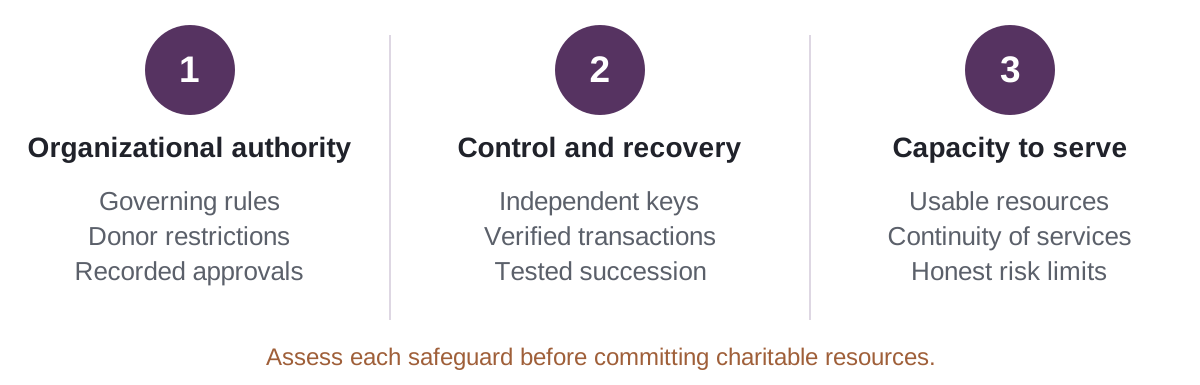
Protect the surfaces.
Use an individual inert, PVC-free holder. Avoid polishing, cleaning chemicals, moisture and handling the faces. Document the exterior before moving the object; consult a conservator for active corrosion.[38]
 Spark HouseWhere Creativity WorksVolunteer Sign In
BITCOIN · CUSTODY · THE COMMON GOOD
A copper object can carry a story, a secret key and a responsibility. Understand what each one means before entrusting it with Bitcoin.
Educational project; receiving arrangements not yet verified. No project deposit address, live balance, audited reserves or completed custody ceremony is represented here. The procedures below are a proposed operating protocol. Never send funds to an illustration or an unverified address.
A PRACTICAL GUIDE FOR COMMUNITY ORGANIZATIONS
A printable guide for Lions clubs, Knights of Columbus councils and assemblies, foundations and other community organizations. It covers governing documents, custody, gifts, payments, officer succession and the ethical questions of Magnifica Humanitas.
Research edition 1 · 9 October 2026. Independent Spark House publication with linked sources and original diagrams. Proposed procedures require adoption under the actual organization’s rules; the guide supplies no receiving address or authorization to hold BTC.
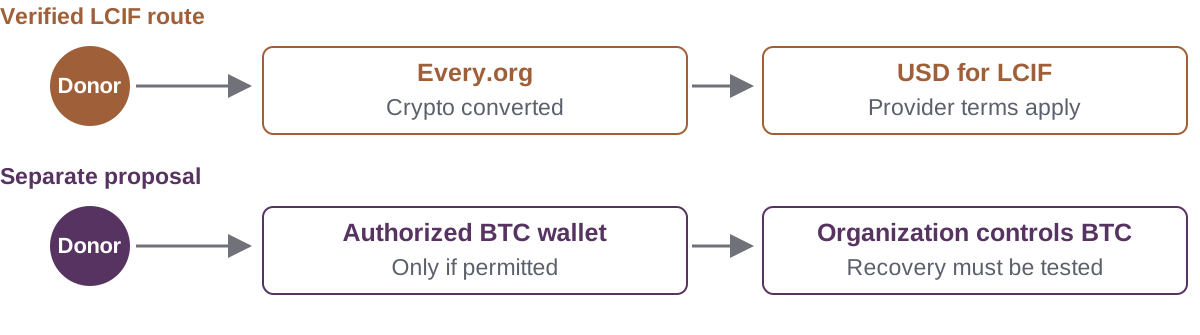
Original diagrams: Three safeguards · Shared custody · Gift routes
01THE COPPER SPECIMEN
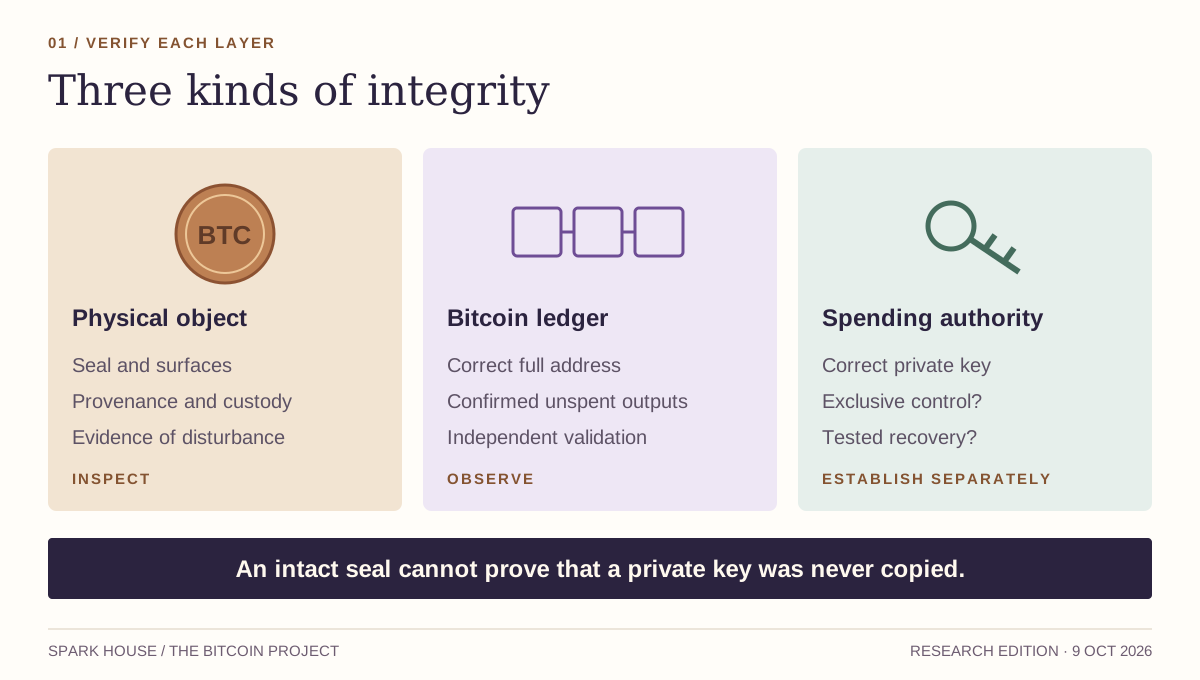
A sound-looking seal, a visible balance and exclusive control of a private key are separate claims. None proves the other two.
The product discussed here is Blockchain Mint’s Cold Storage Coins line. According to the maker, a private key is generated offline, etched into metal and concealed beneath a tamper-evident hologram. Its public receiving address remains accessible. Those are manufacturer claims about the system, not authentication of a particular specimen.[30][33]
The maker describes offline equipment and data-erasure procedures. Those procedures do not let a later owner independently prove that no duplicate key survived. WalletScrutiny identifies this specific “provided keys” trust boundary. That finding is not evidence that the mint has stolen funds.[36]
Compare the hologram, rim, engraving, packaging and custody history with documented specimens. A disturbance may reveal access to the key. An apparently intact seal cannot establish the key’s uniqueness, readability, correct address relationship or future recoverability.[33][36]
Manufacturer provenance tools can support an object’s identity. Blockchain Mint’s BEVIS materials also describe Bitcoin Cash anchoring. A certificate on any chain is not proof of exclusive BTC key control; the project does not adopt the mint’s other currencies.[34]
An undisturbed specimen retains a tradeoff. You can preserve its seal and monitor its public address. You cannot simultaneously prove that its hidden key works, create your own verified key backup, and guarantee nobody ever copied that key while leaving the original seal untouched. Substantial public reserves call for independently generated, tested custody.
02VALUE & PRESERVATION
Metal, collector interest, spendable BTC and purchasing power answer different questions. A physical coin does not contain a guaranteed amount of either Bitcoin or future buying power.
| Value | What establishes it | What remains uncertain |
|---|---|---|
| Metal | Verified weight, purity and the applicable metal market. | No weight/purity assay or current melt appraisal has been performed for the owner’s specimen. |
| Collectible object | Maker, issue, rarity, condition, intact seal, documented provenance and comparable completed sales. | A retail asking price does not establish resale value. Opening, polishing or altering a specimen can affect collector appeal. |
| Native BTC | Confirmed unspent outputs controlled by the correct, usable key, minus the transaction fee required to spend. | A printed denomination or lifetime total received is not the current spendable balance. Spending authority may be shared or lost. |
| Purchasing power | What willing counterparties exchange for BTC at the time of use. | No seal, supply cap or custody system guarantees future prices, liquidity or purchasing power. |
Context from the earlier product review: a standard copper BTC wallet was advertised at US$19.95. This is a historical asking-price observation, not a live quote or valuation of a funded collectible. Quoting the listing does not make USD a project reserve or redemption unit.[35][41]
Use an individual inert, PVC-free holder. Avoid polishing, cleaning chemicals, moisture and handling the faces. Document the exterior before moving the object; consult a conservator for active corrosion.[38]
Keep purchase records, issue details, dated exterior photographs and a transfer log. Record the full public address separately from the short CoinID. Keep custody locations and people’s personal details private.[31]
Metal does not guarantee legible keys after fire. Lopp’s destructive test left the tested markings unreadable; he notes the heat may have exceeded the manufacturer’s claims. Treat it as a limited warning, not a certified fire rating.[37]
Project mandate: native BTC only. Fork currencies, non-BTC tokens, fiat, wrapped claims, leverage and third-party substitutes are excluded from this project’s treasury. The full policy and comparison guide explains those exclusions and the risks that remain.
03PUBLIC CONTRIBUTIONS
For funds entrusted by the public, the strongest improvement is a documented wallet created under independent control. A sealed collectible can remain part of the exhibition without being the sole security mechanism for the treasury.
Authenticate the complete Bitcoin mainnet address using the object, original records and an independent review. Check confirmed unspent outputs through a validating node or a trusted watch-only setup. An explorer is convenient but adds a service dependency and exposes the address you query.[31][10][14]
Photograph only the concealed-key exterior, document handovers, restrict physical access and monitor for unexpected spends. Record the block height, transaction IDs and review time. Monitoring detects activity; it does not freeze funds, insure losses or prove that the concealed key is usable.
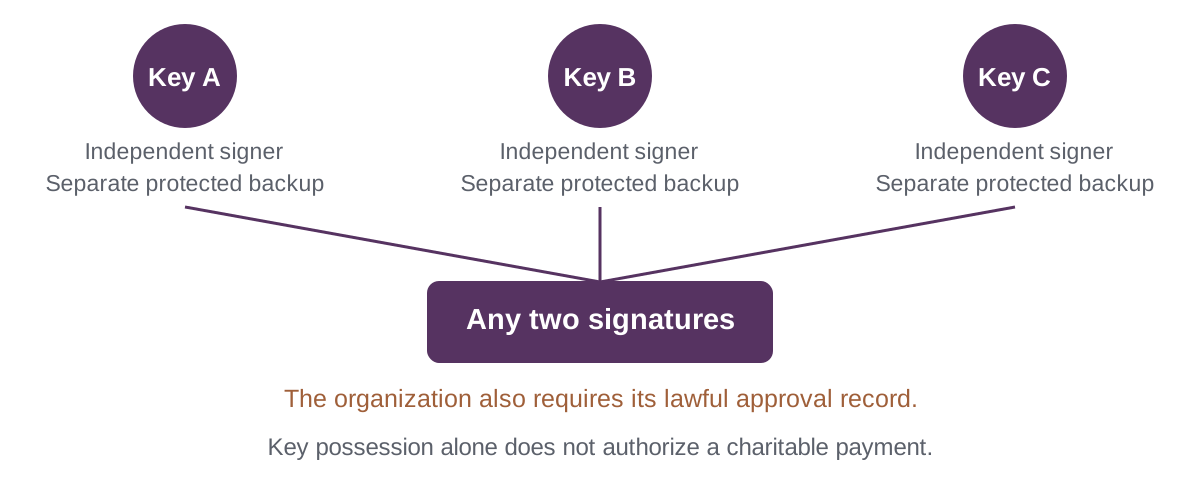
Use a carefully rehearsed 2-of-3 arrangement with independent custodians, separately generated keys and separated secure locations. Verify the complete wallet policy and receiving address on signing devices. A mix of supported signer implementations can reduce a shared vendor failure while increasing operational complexity.[13][14]
Retain the wallet’s script policy, cosigner public data, key origins and derivation information as well as protected signer backups. Some descriptors contain secrets; even public descriptors expose wallet history. Recovery records belong in controlled custody.[11]
INTERACTIVE CONCEPT · NO REAL WALLET
Select signers to see a 2-of-3 threshold. Each signer must hold a different private key.
Illustration only. A real transaction also needs valid signatures, matching script conditions and available unspent outputs. Two colluding signers can spend; one lost key may be survivable, two lost keys may not be. Three devices held by one person do not provide independent governance.
Design basis: Bitcoin’s signature conditions and established wallet guidance. Before any significant deposit, test recovery and a small receive-and-spend cycle with the actual setup, without exposing production recovery material to a networked device.[39][9][40]
| Condition | Actual enforcement |
|---|---|
| Required signatures | The funded output’s script can require a specified quorum. It does not know which person ought to control a key. |
| No spend before a date or height | A correctly designed timelock can enforce a time/height condition. A website promise or one delayed transaction is insufficient. |
| Only this charitable purpose | Donor terms, fiduciary duties, review and accounting. Ordinary multisignature does not evaluate purpose. |
| Keep the coin undisturbed | Physical security and inspection, not a Bitcoin consensus rule. |
| Preserve buying power | No protocol guarantee. A constant BTC quantity is different from a constant market value. |
Existing single-key funds cannot acquire a new quorum or timelock by declaration. They must be spent into a correctly constructed new output, consistent with the original contribution terms. Do not improvise novel scripts for community funds.[15][39]
04PROPOSED OPERATING PROTOCOL
The following is a custody design to adopt and verify before opening contributions. It is not a claim that signers, a wallet or a binding gift agreement already exist.
Name the legal recipient and beneficiary, the native-BTC requirement, allowed purposes, authorization threshold, fees, reporting cadence, privacy treatment, refund rules, dissolution path and who can change restrictions. Explain whether donors receive any redemption right; a donation should not silently become a redeemable investment claim.
Record the complete wallet configuration, separated custodian roles and recovery results. Independently verify the receiving address and QR against signer displays. Publish only the approved receiving information. This site currently supplies no receiving address.
Record transaction IDs, output amounts, confirmation status and time. Set a confirmation policy appropriate to exposure; no fixed number guarantees irreversibility. Small repeated deposits can create many outputs and raise future spending fees. Disclose that a public address makes contribution flows visible.[41][39]
Document the purpose, recipient, amount, fee ceiling and any emergency authority. Two reviewers independently verify destination and change outputs on their signing devices. Use a signed-transaction workflow; no signer should approve an unfamiliar screen merely because another person approved it.[13][40]
Honor the gift terms and document the decision before disturbing the seal. Prepare a verified destination and controlled signing environment. Expose the key only when authorized, then sweep the eligible BTC to the new wallet. Never upload the key to a website, chat, cloud photo service or online QR generator.[32][10]
Confirm the destination transaction, reconcile the remaining outputs, preserve a public expenditure record without donor identities, and retire the old deposit address. Plan for death, incapacity, lost keys, disputes and custodian replacement. Rotation of an actual compromised signing key requires moving funds, not only changing a name in a register.[9][39]
Sweep and import are different. Importing keeps the original key in authority. Sweeping spends to new keys and incurs a network fee. After exposure, the old address remains spendable by anyone with its original key; stop using it. The manufacturer itself advises prompt redemption if you receive a pre-funded coin.[10][30]
For a qualifying Minnesota institutional fund, donor intent and prudent management apply, including diversification unless the statutory exception is justified. A BTC-only mandate does not settle that legal analysis. Have the actual gift terms, fund classification and modification process reviewed before soliciting restricted public funds.[42][43][44]
05THE PAPER & THE WORK SINCE
Nakamoto’s 2008 paper remains the starting point. Later specifications, code, cryptographic analysis and economic research explain both improvements and unresolved questions.
Signatures authorize transfers. Network validation and proof of work address conflicting spends; miners cannot make an invalid signature valid.
The security argument depends on network and attacker assumptions. Simplified verification differs from full validation; settlement is probabilistic.
Fresh keys reduce linkage. A permanently public fundraising address intentionally sacrifices that protection. Contributors should know this in advance.
The paper does not specify the numerical 21-million limit, modern wallet recovery or every rule in today’s implementation. It promises no stable purchasing power.[1]
| Work | Contribution | Boundary of the claim |
|---|---|---|
| Finite-supply guard Bitcoin Core PR 3842 · 2014 | Stops subsidy calculation after 64 halvings. It is a concrete implementation correction. | The associated BIP 42 contains April Fool’s satire; its jokes are not monetary history.[2] |
| SegWit and Taproot Deployed consensus improvements | SegWit revises transaction/witness structures; Taproot adds Schnorr-based spending with selective script disclosure. | These are Bitcoin mainnet upgrades. Neither produces anonymity or removes custody risk. BIP assignment dates are not activation dates.[3][4][5] |
| Bitcoin Backbone Garay, Kiayias & Leonardos · 2015 | Formal analysis of common-prefix, chain-quality and related ledger properties. | Results depend on the model’s hashpower, network timing and cryptographic assumptions; they do not certify every deployed program.[6] |
| Selfish mining Eyal & Sirer · 2014 | Shows how strategic block withholding can alter incentives under modeled conditions. | Profitability depends on assumptions such as propagation advantage. It does not let miners forge users’ signatures.[7] |
| Fee-dominated security Carlsten and colleagues · 2016 | Studies incentive problems when fees dominate mining rewards. | The authors’ theory and simulation identify uncertainty; they do not predict inevitable failure or measure today’s attack rate.[8] |
Reorganizations, censorship pressure, concentration, changing fee economics.
Implementation defects, compromised updates, key-generation failures and future cryptanalysis.
Loss, theft, collusion, coercion, inaccessible recovery and incorrect transactions.
Volatility, liquidity constraints, real-world expenses and uncertain future acceptance.
These are risk categories, not measured probabilities or a forecast. Excluding alternative assets does not remove them.[41][4][9][8]
06CATHOLIC SOCIAL TEACHING
Truthfulness, justice, solidarity, subsidiarity and care for creation guide how entrusted assets should be used. A technical protocol does not replace these responsibilities.
These are project applications of the texts below, not Church approval of a wallet or monetary policy.
| Official text | Relevant teaching | Application here |
|---|---|---|
| Catechism 2402–2404; 2407–2412 | Ownership carries stewardship; just promises and obligations matter. Manipulative speculation and misuse of common assets are condemned. | Protect beneficiaries, document restrictions and never appropriate entrusted BTC for private purposes.[18][19] |
| Caritas in Veritate Benedict XVI · 2009 · 45, 65–66 | Finance should serve human development; an ethical label requires substance. | Measure community benefit and responsible conduct rather than treating price appreciation as a moral achievement.[21] |
| Oeconomicae et pecuniariae quaestiones 2018 · 26 | Derivatives can insure risk, while opaque layers can distort valuation and accountability. | Explain hedging benefits honestly while choosing to exclude derivatives from this project.[22] |
| Laudato Si’ / Fratelli Tutti Francis · 2015 / 2020 | Transparent environmental assessment, human dignity, social purpose and limits of market solutions. | Publish dated environmental evidence, hear affected communities and keep beneficiaries central.[23][24] |
| Antiqua et Nova 2025 · 44–46 | People retain moral responsibility for decisions assisted by AI. | Human custodians verify evidence and authorize transactions; an AI recommendation is not spending authority.[25] |
| Magnifica Humanitas Leo XIV · 15 May 2026 · 71–72, 95–99 | Human dignity, participation, accountability and independent checks in the exercise of digital power. | Use visible governance, distributed responsibility and meaningful review.[26] |
Interpretive boundary. Applying these teachings to Bitcoin is Spark House’s interpretation. The reviewed texts do not endorse Bitcoin, Blockchain Mint or a BTC-only treasury, and do not condemn the USD as such. Neither the Catechism nor the derivatives document condemns every investment risk or every derivative.
07ENERGY & ENVIRONMENT
Proof of work consumes real resources. Its impacts depend on electricity sources, timing, location and the alternatives displaced. A single network-wide percentage cannot settle a local environmental question.
Cornell researchers modeled mining revenue at renewable installations before grid connection. Potential benefits depend on location, timing and otherwise available electricity. This is not proof that every mine lowers emissions or that mining is the best use of renewable generation.[28]
A 2025 Nature Communications study modeled pollution linked to 34 large US mines during August 2022–July 2023. Its electricity and dispersion estimates identify community exposure concerns; they are not a current global census. Input uncertainty and regional modeling limits remain material.[29]
—PRACTICAL QUESTIONS
Anyone can send BTC to a valid public address. Each deposit increases exposure to the same hidden key and its unknown copies. A growing visible balance does not strengthen the seal or improve recovery. For public reserves, establish independently controlled custody and disclose the destination before collecting more.
No. It establishes ledger activity for an address, subject to verification. The hidden key might be damaged, wrong or unavailable, or someone else might also possess it. A watch-only wallet cannot prove recoverability. An incomplete historical scan can also miss funds.[10][12]
A label records a human statement. It cannot alter the spending conditions of an already funded output. Changing cryptographic authority requires an authorized on-chain transaction; changing gift restrictions also requires the applicable donor and legal process.[39][44]
No. Lightning is a BTC payment layer with channels and Bitcoin settlement. It adds availability, liquidity, state-management and provider risks. This project does not enable Lightning receipt or substitute a Lightning service balance for its mainnet reserve. See the layer distinction.[16][17]
No. Physical preservation protects an artifact; secure custody protects spending authority. Neither fixes what BTC will buy. A Bitcoin-only policy is an asset mandate, not insurance against price changes.
Clear photographs of the exterior, maker’s marks, year, material, packaging and the intact seal can support identification. Conceal personal records and storage details. Never expose or send the private key, recovery words or an opened-key photograph to this website or an assistant.
08ANNOTATED PRIMARY SOURCES
Open a reference to see what was read, what it supports and where its conclusions stop. Manufacturer claims, technical specifications, research findings and Church teaching remain distinguishable.
58 of 58 references · reviewed 9 October 2026
Foundational design for peer-to-peer electronic cash and double-spend resistance.
The deployed change prevents undefined large right shifts from allowing subsidy calculation to restart after 64 halvings.
The document marks SegWit as deployed and as a consensus soft fork.
The deployed specification defines 64-byte Schnorr signatures over secp256k1.
The deployed consensus soft fork introduces a SegWit v1 output type using Taproot, Schnorr signatures and Merkle branches.
Formalizes common-prefix and chain-quality properties in a static-participant model with a random-oracle treatment of hashing.
DOI: 10.1007/978-3-662-46803-6_10
Under its model, strategic block withholding can yield more relative revenue than the miner's hashpower share.
DOI: 10.1007/978-3-662-45472-5_28
Models fee-dominated mining and identifies undercutting and selfish-mining incentives absent or weaker under fixed subsidies.
DOI: 10.1145/2976749.2978408
Separate small operational balances from savings; make comprehensive backups in multiple secure locations and plan succession.
Import adds existing key control; sweeping makes a transaction that sends its funds to an address derived from the destination wallet's seed.
Keys alone can omit script type and derivation details necessary for reliable recovery; descriptors specify that missing structure.
Importing descriptors triggers a rescan based on timestamp and requires a new backup.
Initialize a new wallet under your control and securely preserve the device-generated recovery material.
For its advanced cold-storage workflow, Sparrow recommends at least 2-of-3 multisignature, multiple hardware vendors, and separated secure locations and backups.
A locking script can prohibit spending an output before the specified block height or block time.
Lightning is a layer-2 protocol for off-chain bitcoin transfers with on-chain enforcement when necessary.
The original design identifies timing, mass channel-expiration pressure, hot-key compromise, state loss, and late on-chain response as risk classes.
Legitimate property serves freedom and basic needs, while ownership entails stewardship and the universal destination of goods.
Condemns fraud, manipulative speculation and misuse of common assets; requires just promises, contracts, debts and restitution to be honored.
Profit cannot be the exclusive end; business managers owe responsibility for economic and ecological effects and the good of people.
Finance should serve development. Ethical labels require discernment; responsible innovation, protecting weaker parties and discouraging abusive speculation matter.
Recognizes derivatives can insure identifiable risks; warns that layered complexity can obscure valuation and distort risk. Calls for social responsibility in saving and investing.
Calls for less harmful energy, transparent early environmental assessment, local participation, comparison of alternatives and precaution regarding serious irreversible harms.
Property has a social purpose, people deserve dignity and opportunity, and markets alone do not solve every social problem.
Humans retain moral responsibility for AI-assisted decisions; accountability, transparency, robustness and environmental costs require attention.
Applies subsidiarity to digital power through transparency, accountability, participation and independent checks; prioritizes human dignity, solidarity and protection of the vulnerable.
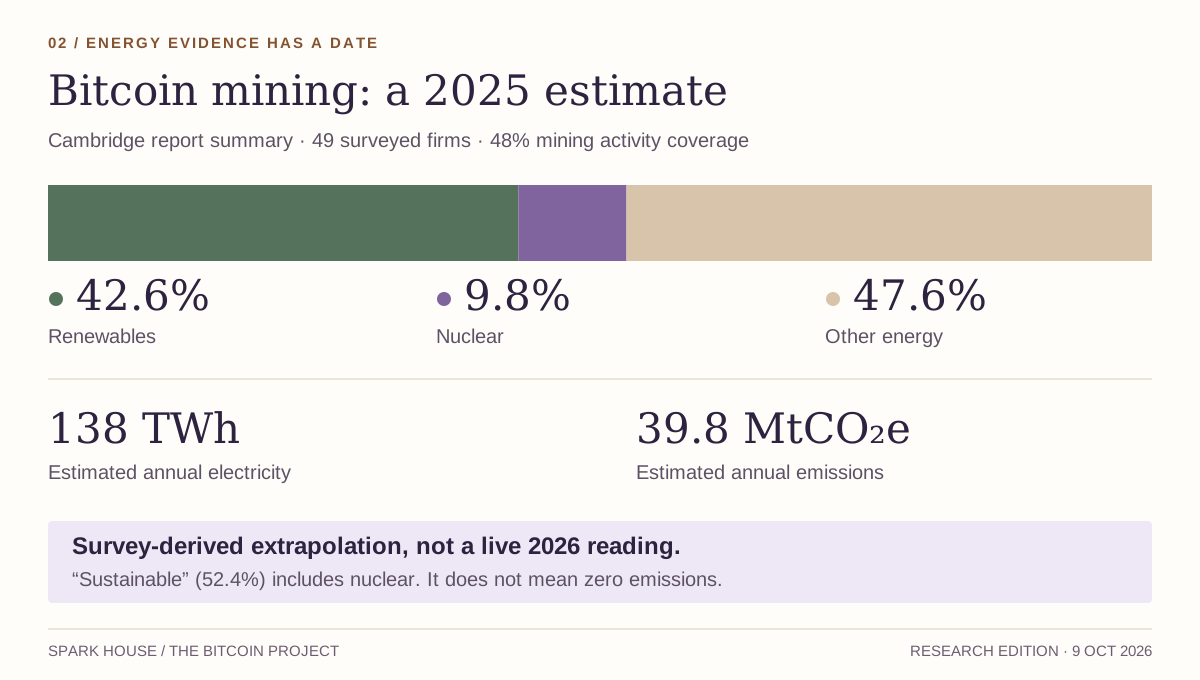
A survey of 49 firms covering 48% of mining activity estimated 138 TWh annual network electricity and 39.8 MtCO2e emissions. Reported sustainable mix was 52.4%: 42.6% renewable plus 9.8% nuclear.
Models possible mining revenue at planned renewable installations before grid connection; benefits depend on location and electricity availability. Also acknowledges hardware obsolescence and material costs.
DOI: 10.1021/acssuschemeng.3c05445
Models 34 large US mines: estimated 32.3 TWh consumption and 1.9 million people exposed to at least 0.1 micrograms/m3 of additional PM2.5. These are model estimates for a historical sample.
DOI: 10.1038/s41467-025-58287-3
Describes manufacturer-generated keys and single-use redemption. Advises redeeming a preloaded coin promptly.
Public address lookup and CoinID help identify the intended receiving address.
Explains uncovering the etched key and retiring the exposed coin address.
Describes a KURZ/OVD Kinegram tamper-evident seal.
Describes asset provenance and certificate anchoring, including Bitcoin Cash.
A standard copper BTC wallet was listed at US$19.95 during the initial review.
Flags manufacturer-provided private keys: deletion by the provider cannot be independently established.
The tested specimen’s private-key markings became unreadable under destructive heat testing.
Avoid cleaning collectible coins; use protective holders and avoid PVC and acidic storage materials.
An output’s spending conditions govern which signatures authorize a valid spend.
Explains online watch-only preparation and offline transaction signing.
Discusses price volatility, irreversible payments, public history and confirmations.
Qualifying institutional funds are subject to donor intent and prudent management, including a diversification rule with a stated exception.
Definitions include gift instruments and institutional funds.
Provides mechanisms and conditions for release or modification of qualifying restrictions.
Describes the 2017 Bitcoin chain split and an emphasis on larger on-chain capacity.
Documents the 2018 split from BCH into BSV.
Documents changed block-limit settings and operator configuration.
A separate currency and codebase adapted from Bitcoin.
A separate code-derived currency; not Bitcoin mainnet.
Explains continuing issuance of roughly five billion coins annually.
Explains Ethereum’s stake-based validation, penalties and slashing.
Describes token issuance and custody of backing BTC.
Discloses redemption, issuer, technology and value risks.
Provides exchange-traded Bitcoin price exposure through a trust and custodian.
Describes cash-settled Bitcoin futures tied to a reference rate.
Margin, leverage, market disruption and option-writing can create substantial losses.
Explains the FOMC’s longer-run 2% PCE inflation objective.
Explains insurance for qualifying deposits at insured banks.
This is a curated, expandable editorial reference set, not an exhaustive review of all scholarship or Church commentary. Reading scope is stated per source. Crossref metadata verification is distinct from reading a paper. Sources may support, qualify or challenge the project; inclusion is not endorsement. Search runs in your browser.